Community Connections
Snapshot
- Date/Location: March 2020, State College, PA
- Recruitment tool: Internal database, internal listservs
- Research type: Mixed methods
- Methodologies: Surveys
- Population: State College, PA community members aged 65-85; Penn State faculty
- Testing software: Qualtrics, Google Forms
- Supporting Technologies: Adobe InDesign, Microsoft PowerPoint, Keynote
- Primary impacts: Enhanced community-researcher interactions, improved researcher recruitment satisfaction
Background
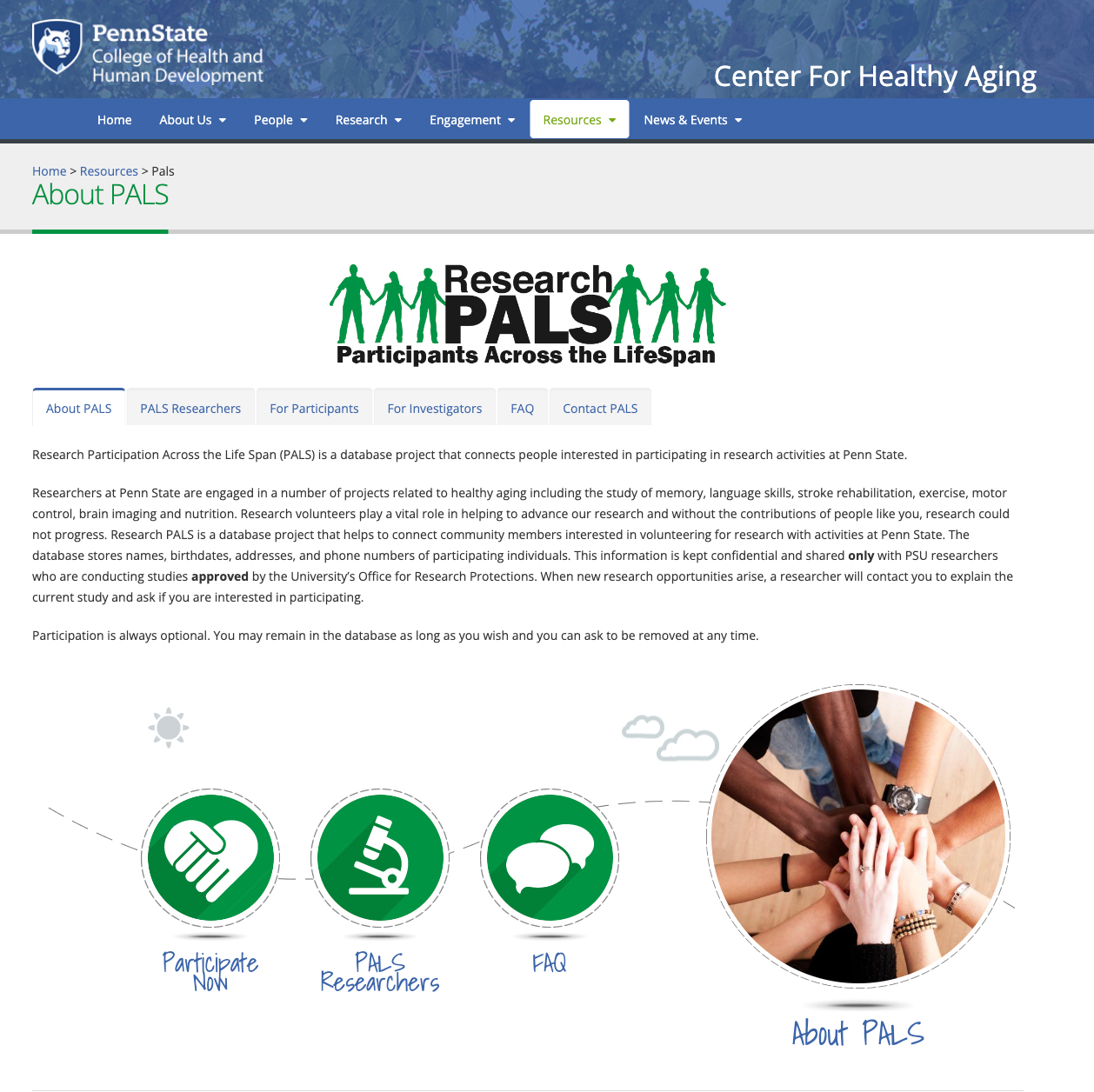
Research Participants Across the Lifespan (PALS) is a database project that connects older members of the community (aged 60+) with research activities at Penn State. In March 2020, PALS had to pause research in order to transition from in-person to virtual testing.
Stakeholder Conversations
I organized several conversations with key stakeholders to define success metrics (community satisfaction, researcher satisfaction, and database growth), propose a research plan, and establish touch bases to ensure continuous stakeholder-researcher alignment.
Goals
The goals of this study were twofold: 1. Facilitate community interest in research participation through digital mediums; 2. Allow researchers to connect and engage with community members.
Objectives
- Create a digital space for both researchers and older community members to uphold research connections during the COVID-19 pandemic.
- Accommodate older community members who lack experience using digital platforms.
- Accommodate researchers who were unaccustomed to virtual recruitment and participant connection.
Two-Pronged Approach
To drive for a two-pronged research approach, I created a research plan for two distinct groups: With community members: Understand desirability towards participating in research a) during a global pandemic, and b) in an online setting.
With Penn State researchers: Provide recommendations for what resources should be used to host participant interaction, data, and payment.
Methodology
For community members, I wrote and designed two exploratory surveys to determine 1. Community willingness to participate in research, and 2. Target audience technological familiarity and aptitudes. Participants were recruited from the PALS database. They were required to be between the ages of 65-85 and live in the greater State College, PA area. The surveys were written in Qualtrics and Google Forms, respectively, and disseminated to community members via MailChimp. Each survey took participants an average of 15 minutes to complete.
For Penn State researchers, I wrote and designed a survey to determine what sort of technical capabilities would be needed for hosting experiments online. Participants were Penn State faculty members who conducted research within the Departments of Psychology, Human Development & Family Sciences, Language Science, and Engineering. The survey was written in Google Forms and disseminated to researchers via an internal listserv and took participants an average of 9 minutes to complete.
Synthesis and Analysis
Over the course of one week, all three surveys were independently subjected to analysis. Ordinal data produced descriptive statistics or were subjected to a Pearson correlation. Qualitative questions were submitted to a content analysis.
Results
Overall, my analysis of all three surveys suggest both community members and Penn State researchers desire online research opportunities. For community members, an ideal research platform would be easy to use, would not require a login, and provided the option to get paid either online or through the mail. They also wished to be informed about studies they had previously participated in. For researchers, the research platform would be accessible, have reliable data storage, and was free/affordable.
Recommendations
I provided two primary recommendations. First, enhance the PALS website to make it more user-friendly and informative. This would allow Penn State researchers have a consistent place to post study opportunities. Community members would also be able to express their interest in a posted study using a simple, embedded form on this website. Next, I suggested publishing a regular newsletter highlighting past research to inform community members on the impact of their previous participation, as well as incentivize future participation from community members.
Collaboration
This project was a collaborative effort across several disciplines. I received feedback from principal investigators, postdocs, and graduate students research planning. After analyzing the results of the study, I communicated the findings back to each respective discipline to ensure the human-centered insights I uncovered were incorporated into the PALS website edits.
Shareout & Impact
Results and recommendations were delivered to key stakeholders via Microsoft PowerPoint and low-fidelity mock-ups. Due to this research, we collaborated with a web developer to improve the usability of the PALS website. I also created a newsletter in Adobe InDesign that was sent out monthly until in-person research resumed. Collectively, this study enhanced community-researcher interactions and improved researcher recruitment satisfaction.